
Cremation is quickly becoming the world’s most popular way to lovingly dispose of the remains of a loved one who has died. Cremation industry analysts routinely predict increasingly larger and larger increases in the number of cremations annually in the United States and throughout the rest of the industrialized world. (In undeveloped regions, the expense of building cremation ovens and establishing production lines for cremation urns has contributed to slow growth, but even in those parts of the world, traditional funeral pyres for non-mechanical cremation are still quite common and perhaps growing in popularity.) In fact, these experts predict that by 2017 cremation will be practiced in at least 75 percent of all deaths across the world. Remarkable when one considers that in 1990, that figure was at just over 40 percent.
The rise in popularity of cremation is usually directly attributed to the great variety of things that a family can do with the cremation ashes of their beloved family members who have died. Cremation urns are available in ever increasing varieties and styles, and displaying the ashes permanently in an urn is just the start of what a family can do with a loved one’s cremated remains. Many families want to split the remains among several sets of relatives using smaller keepsake urns. Many also bury at least a small portion of the remains in some special place – whether it be a traditional grave yard or not is entirely up to the family’s tastes (or even budget). And still others scatter at least a small portion of the cremation ashes over some special (even sacred) spot that was important in the life of the deceased.
And when it comes to this last option, families are increasingly choosing to scatter the remains over water. (Though of course this is not the only option.) Statistics are not kept reliably by industry groups at this point, but most educated guesses are that scattering cremation ashes in water is by far the most popular choice, some estimates say up to 75 percent of scatterings are done in watery locations.
Where Scattering Cremation Ashes on Water Is Legal
One of the main questions that always comes along with the idea of scattering cremation ashes on water is simple legality. While it is true that many families do not fuss over such formal legal matters when deciding how to dispose of the loved one’s remains, it also quite common that families will be uniquely concerned about the legality of their plans. No one wants that their family’s most sacred, memorable and important memorial traditions will be marred by a run-in with authorities trying to enforce laws. Unplanned jail time or fines – or even a brisk discussion with police officers or code enforcement personnel – is not the sort of thing that any family wishes to bring upon its members, especially during a time of great grief over the loss of a precious family member.
So, the best advice we can offer in the regard of staying legal with ash scattering plans is to simply make sure with local authorities that all plans are legal. Any possible mis-interpretations or misunderstandings of local laws are best worked out in advance, while calm heads and prevail and a peaceful, uplifting solution can be found.
It is difficult for us to summarize with any accuracy the nation’s widely varied laws about spreading cremation ashes over water. But we do have a few guidelines that can be offered with caution.
In general, spreading ashes in water is legal in areas that are at least 3 miles off shore. In these international waters, there is typically no restriction against spreading a relatively small amount of cremation ashes into the water. That said, if you or your family intend to spread the cremation ashes of multiple people over a spot, it might be good to check with coast guard or other maritime officials. While it is unlikely that a typical number of mutliple cremations – say up to 5 or 6 – will likely be in any violation of federal or state pollution laws, the main legal concern after a boat has traveled 3 miles into a sea will be simply pollution. Regulators may view multiple cremations as “industrial waste” that is heavily regulated by any number of agencies – maritime or otherwise.
Aside from three miles off-shore, anyone wanting to spread the cremation ashes of a loved one over land on private land will, typically, not face any legal challenges so long as the land owner has given permission. This does assume that the party spreading the ashes is not in violation of any pollution laws as mentioned above. Most legal issues related to cremation ashes that are not strictly mentioned in laws are related to concerns over keeping water quality high and more or less pollution free. But, if your scattering party has obtained permission from a landowner to spread ashes over a particular inland body of water, it is best to get a record of that permission in writing and to be sure to to keep that permission nearby as the scattering ceremony is happening. This will keep problems to a minimum in the event any authorities may notice the scattering and request information about the authority by which it is being done.
Where Cremation Ashes in Water is Not Legal
Cremation scattering is, for all practical purposes, not permitted in coastal areas, swimming pools, or any other private area that directly empties into a public body of water or whose sewage connected back to a public body. This is not applicable in most cases, of course, if the land owner has provided written permission of the scattering. In general, the concern about scattering ashes over public waters is, officially speaking, over sanitation, but that is an outdated concern. Study after study from the scientific world have shown that cremation ashes pose not a hint of a threat to the public health of anyone involved (or for that matter, to the environmental health). So the roots of the objections to scattering ashes over public waters is simply a matter of taste and emotional sensibilities. It is for this reason that many experts advise families who wish to scatter their loved one’s remains over water to simply stick to a few guidelines:
Avoid all areas that specifically have signs prohibiting the spreading of cremation ashes, and be certain to not do anything unnecessary to call attention to yourselves as you spread the ashes. Many witnesses to an ash scattering ceremony will not recognize that’s what they are seeing, and, so long as the scattering is not specifically prohibited by a sign, it is unlikely that an unobtrusive party will be given any hassle from those who may see what is happening. It is true that most of the places that specifically outlaw cremation ash spreading are those that are already over historic grave yards or some other potentially historic site. Archaeologist often declare, and announce, that their dig sites are off limits for cremation ash scattering simply because they are trying to reduce the competing historical influences on the sites under their management. Having a person’s ashes scattered over a particular spot makes the area subject to great historical interest later. This would put the modern times at odds with history, and that is a situation most archaeologists would like to avoid for a while variety of reasons.
How to Scatter Cremation Ashes in Water
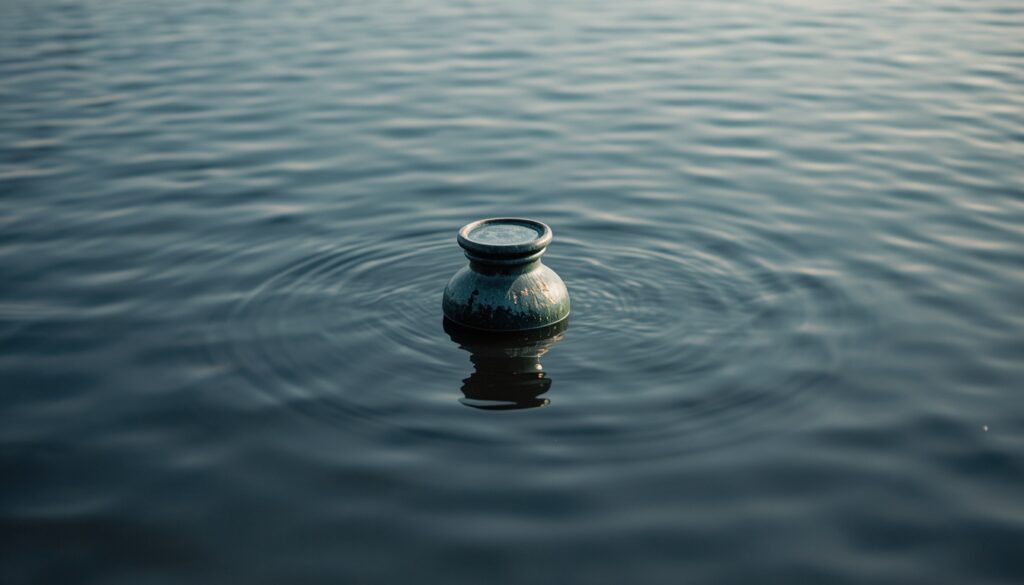
The best way to scatter cremation ashes while assuring that the party doing the job will not end up in conflict with laws is to find a way to gradually release small amounts of the remains over a significant distance of the water. This will assure there will be little visual evidence of the remains – that the particles in the ashes will mix seamlessly into the water’s elements and contain no potentially upsetting remains for future passers-by to find. The best way to accomplish goal, many have found, is with the use of biodegradable cremation urns that users simply fill with the deceased’s remains. Once filled, the urn is lowered (perhaps even tossed ceremoniously) into the water and spectators may watch it float gracefully for several minutes – up to a half-hour – before it begin to sink. Once the urn has reached its saturation point, it will slowly descend to the sea floor where it will rest for a short period before it breaks up into microscopic pieces through the natural process of degradation. Once it has fully disintegrated, the urn will assure that the human remains will be safely dispersed across the body of water, unidentifiable in any way by observers.
The alternative this method of scattering cremation ashes across water is to simply toss the ashes from an urn into the water. This is risky, however, because, on windy days, anyone standing nearby may end up with the unfortunately experience of having the remains blow back onto his or her body or clothes. For some, of course, that might be a humorous incident, but for many others, it would be quite traumatic and emotional. It is for this reason that this practice, while once common, is not recommend – especially with the advent of biodegradable cremation urns that are quite convenient and affordable.
Things Not to Do When Scattering Cremation Ashes In Water
We end with a few final thoughts on how experts typically recommend families do not scatter the cremation remains of their loved ones who have requested they be spread over water.
One of the most important things to keep in mind is that cremation urns should never be tossed directly into the water – especially in areas that are near shore. Even the international law requiring most deep sea burials or cremation scatterings be unregulated when done at least three miles from a nation’s shore does not protect against a cremation urn being gradually pushed ashore by tides, currents or other natural forces. This means that there is a good possibility that any cremation urn buried at sea will turn up on a beach – or perhaps in a fisherman’s net – eventually. That will not be a comforting site for the discoverer.
While it is true that full-burials at sea also carry the same risk, it is also true that, in most cases, a burial at sea is a less susceptible to such problems simply because a body will naturally biodegrade under the sea in a relatively quick period of time – usually well before it would have opportunity to wash ashore anywhere if it were be buried at least 3 miles from shore. A cremation urn, on the other hand, would likely be able to whether the undersea elements for many years – perhaps even decades or centuries if the urn is made of some sturdy metal or stone. While it may be a romantic notion for some that his or her remains might be discovered in tact in a cremation urn many years after they were tossed overboard on a ship, a compassionate view would include the shock a person who would discover such a surprise. No matter whether tossing a complete cremation urn into a body of water is legal or not (and, in most local areas, it is not legal), it is still a matter of great dignity and even compassion for those who might have occasion to come across the piece in the future. It is one thing to have a cremation urn uncovered from a gravesite by archeologists and others who have been duly warned of its existence by a grave marker or some other evidence that an urn is buried in a particular spot. It is quite another thing to simply find a cremation urn mixed in with a good catch of fish or, perhaps, as part of a relaxing beach combing session. In deciding how to dispose of a body’s cremation ashes in water, it is always a good idea to consider the emotions of those who may find an urn many years into the future.